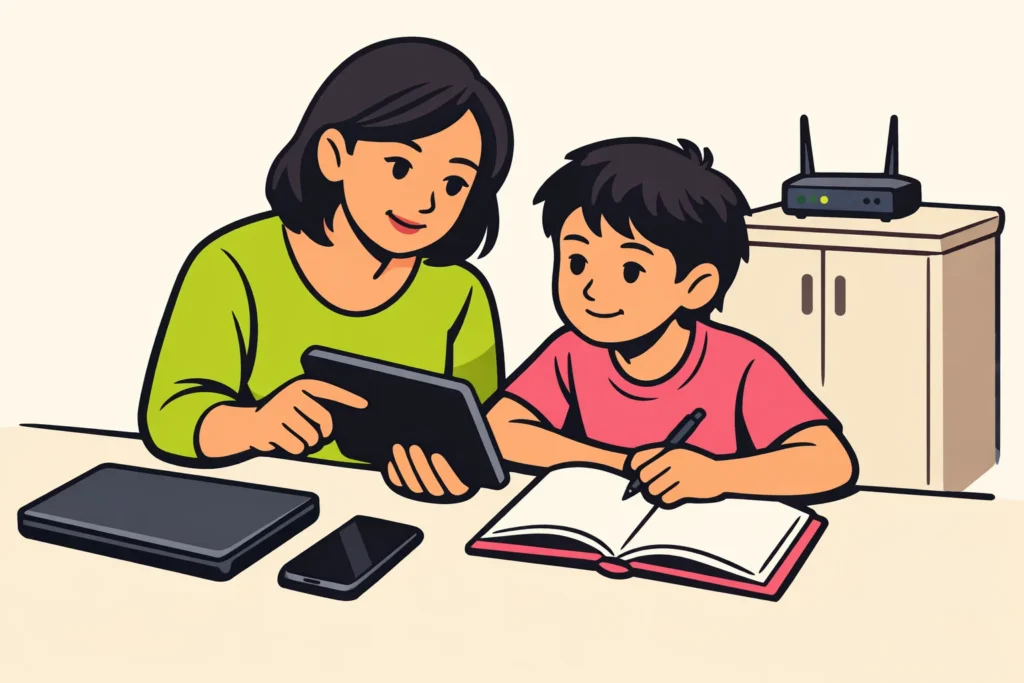
Blocking YouTube starts on the device you watch on. For your child, open parental controls such as Screen Time or Family Link. If you want fewer distractions yourself, choose a temporary website block. Always check both the app and the website. Removing the app alone is not enough: YouTube may still be accessible through a browser.
Below, see which of the eight ways suits you and follow the steps for your device.
Which way of blocking YouTube is right for you?
First, decide what you want to prevent. Blocking YouTube completely requires different settings from reducing watch time or blocking one channel.
| What do you want? | Start with this | Keep this in mind |
|---|---|---|
| No YouTube on your child’s mobile | Parental controls on the device | Block both the app and the website |
| No YouTube during homework | A temporary block or time limit | Check whether your child needs a video for school |
| Fewer distractions on your own laptop | A website blocker with a schedule | Test your other browsers too |
| No YouTube on multiple devices at home | Router rules or a DNS filter | Mobile data and other networks are outside your home network |
| Keep out only certain videos or channels | Settings within YouTube Kids | Check whether standard YouTube is still accessible |
| Filter possible adult content | Restricted Mode | YouTube remains accessible |
Do you use the same computer? Give your child their own user account and test the block from that account. When managing restrictions, choose a different code from the usual unlock code.
1. Block YouTube on iPhone and iPad with Screen Time
Open Screen Time in your iPhone or iPad settings. There, you can view options for apps and websites separately. The options you see may depend on the software version and your family settings.
- Choose whether you want to block YouTube completely or only limit watch time.
- View the app restrictions. Set a time limit if you want less watch time. Even a short limit still provides access.
- Want to remove the app? Check whether you can also restrict reinstalling it.
- Find the web content restrictions. Add YouTube to the blocked websites if that option is available.
- Secure the settings with a code. Then test the app and website on your child’s device.
Dealing with the app alone may leave the website open. So also try YouTube in a second browser, if one is installed on the device. Can’t see a setting? First check whether you are managing the right device or family account.
2. Block YouTube on Android with Family Link
Do you use Family Link for your child? First select the right child and device. Then check which rules you can set for the YouTube app. The options are not the same on every mobile.
- Find YouTube in the list of apps you can manage.
- Choose a block if that option is available. For less watch time, check the time limits.
- Also restrict access through the browser. The following explanation about Chrome will help you do this.
- Open YouTube on your child’s mobile to see whether the setting works.
Another user profile or a browser outside the controls may still provide access. Removing the icon from the home screen does not help: it does not block the app.
Is YouTube not listed among the apps you can manage? Check whether you selected the right account and device. A blocked website does not mean that the app is also blocked.
3. Block YouTube in Chrome and on Chromebook
With Family Link, you can block websites in Chrome. On some devices, your child may bypass the controls by signing out or using another browser.
- In Family Link, select your child’s account.
- Find the website settings in Chrome.
- Add YouTube to the blocked sites. Check whether you are blocking one address or an entire domain: the name of a website.
- Open Chrome with your child’s account and test whether YouTube still opens.
Try youtube.com, www.youtube.com and a short video link via youtu.be. This tests different addresses. It is not a complete list of all connections YouTube uses.
On a Chromebook, also check whether your child can use another account or the guest function. Is it a school device? Only the administrator may be able to change certain settings.
4. Block YouTube on Windows with Family Safety
For a family computer, you can look at Microsoft Family Safety. First have your child use their own Windows account. Testing from your account does not show what your child can open.
- Check whether your child’s account is covered by your family settings.
- Check whether you can filter websites for that account and device.
- Read which browser the filter works with. A rule does not automatically apply to Edge, Chrome and Firefox.
- Add YouTube to the websites you want to block.
- Sign in with your child’s account and try YouTube in every installed browser.
Your child may still be able to watch through a browser where the filter does not work. Also check whether your child can install apps or change the family rules.
5. Block YouTube through your router
Your router distributes the internet connection at home. Some routers have website filters or parental controls. These can restrict multiple devices without changing settings separately on each device.
- Open your router settings. Follow the instructions in the manual.
- Look for website filters or rules that you can set per device.
- First choose one device to test the block.
- Block YouTube with the available website filter. Then try the app and website.
- Does the rule work as you want? Apply it to the other devices you want to restrict.
This block does not apply when the device uses mobile data or another network. Router filters do not all work the same way either. If a video keeps playing, that does not necessarily mean you entered something incorrectly.
Suppose you only want to restrict the tablet during homework. If possible, choose that tablet in the router settings. This means you do not have to restrict the entire home network.
6. Block YouTube with a DNS filter
DNS helps a device find a website’s internet address. A DNS filter can block certain addresses. You can set up such a filter on a device or on your router.
- Choose a filtering service that lets you block websites or services yourself.
- Check whether you can block YouTube separately. A filter for adult content does not do the same thing.
- Follow the service’s setup guide for your device or router.
- After setting it up, test both the YouTube app and the website.
The filter can be bypassed if a device uses different DNS settings or a VPN. A VPN routes the internet connection through another server.
A DNS filter can also block something you actually need. Think of a YouTube video on a school website. So check those pages too.
7. Block YouTube through the hosts file
The hosts file is on your computer. You can use it to direct a website address to another address. Choose this method mainly for your own computer if you have experience with system settings.
- Make a copy of the original hosts file before changing anything.
- Use instructions for your operating system to open the file with permission to modify it.
- Add only the website addresses you want to block. Leave the existing rules in place.
- Test whether YouTube is blocked and whether other websites still open normally.
An example rule is 127.0.0.1 www.youtube.com. It sends that one address back to your own computer. This does not block all the connections YouTube uses.
Other addresses may still work. Someone may also undo the change. The rule applies only to this computer, not automatically to your mobile or tablet. Don’t want to change system files? Choose device management settings instead.
8. Temporarily block YouTube with a website blocker
Want to stop yourself from repeatedly opening YouTube during a task? Use a website blocker, such as a browser extension. Before installing it, check what access it requests to data about your website visits.
- Choose a blocker that works in the browser you usually use.
- Add YouTube to the list of blocked websites.
- Set a time period if the blocker offers that option.
- During that time period, try opening YouTube.
- Put your mobile out of reach if you would otherwise continue watching on it.
For example, you can block YouTube from 19.00 pm to 20.00 pm while completing an assignment. Do you need an instructional video for it? Watch it beforehand or set aside time for it separately.
Another browser or device may still provide access. You may also be able to disable the extension. For your own focus, this extra step may be enough. As the only form of parental control, a website blocker is less suitable.
Restrict YouTube with YouTube Kids or Restricted Mode
Want to continue allowing videos but not show everything? Look at YouTube Kids or Restricted Mode. They do something different from blocking YouTube completely.
Block a video or channel in YouTube Kids
In YouTube Kids, you can block videos and channels. Blocking a channel does not automatically prevent reposted videos and similar channels.
Is it about one channel? Then read the explanation about blocking a YouTube channel.
Also check whether your child can still open standard YouTube. Setting up YouTube Kids does not shut off the standard service. You need to arrange that separately.
Filter possible adult content with Restricted Mode
Restricted Mode may filter adult content, but it does not block all unsuitable videos. YouTube remains usable. This mode therefore does not replace an app block, website block or time limit.
Check whether YouTube is really blocked
Test on the device and from the account for which you set the block. Go through these points:
- App: fully close YouTube and reopen the app.
- Website: try the home page and a link that goes directly to a video.
- Browsers: test every browser on the device.
- Accounts: check whether YouTube works through another profile or as a guest.
- Connection: are you using a block on the home network? Also test mobile data, if the device has it.
- Other websites: open a page containing a YouTube video.
- Settings: check whether your child can disable the block themselves.
Can you still open YouTube somewhere? Adjust the setting that applies to it. If the website still works, check the website filter. Removing the app again will not help with that.
Repeat the check after a major update or when you start using a new device. Once your account is working as intended, you can explore our YouTube services to compare packages for subscribers and views for your public profile or content.