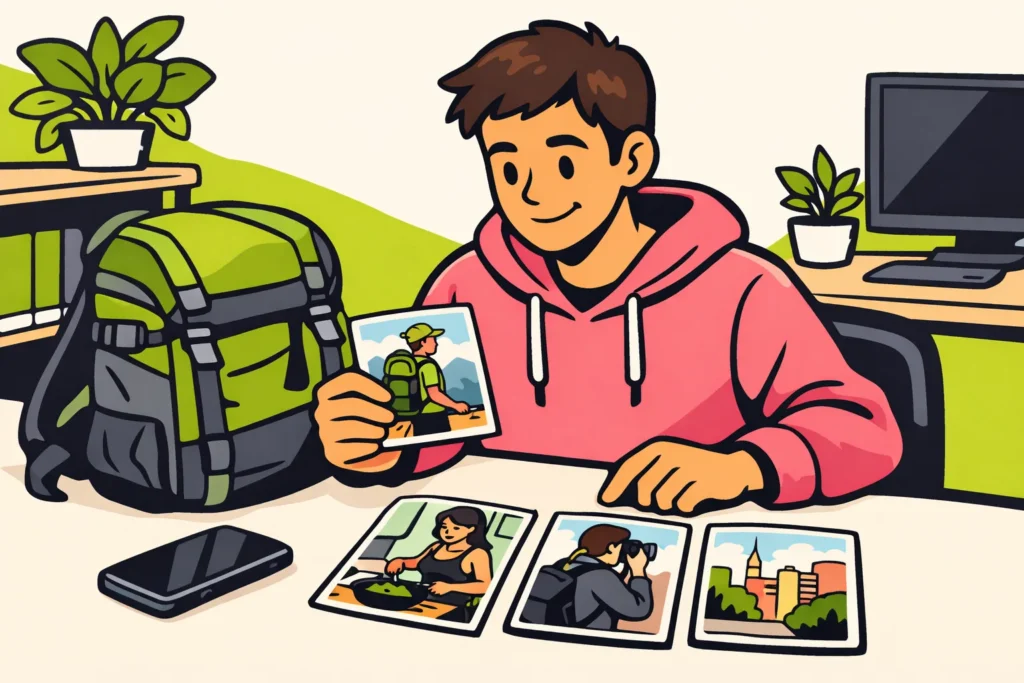
You can find Instagram influencers through your own followers, keywords, hashtags and locations. First write down which subject, region and audience fit your idea. Then make a shortlist of creators and review their posts, comments and audience data. Look beyond the number of followers: the creator and the audience must fit what you want to show.
Below, you will read where to search, how to choose suitable creators and what to agree on for a collaboration.
Which Instagram influencer fits your goal?
Describe in one sentence who you are looking for and what for. This lets you check each profile to see whether it fits your plan.
A fictional example: ‘I am looking for a creator who talks in Dutch about hiking around Antwerp, for a video about our hiking backpack.’ You then have three clear search points: hiking, Antwerp and posts in Dutch.
- Goal: Do you want a product explained, visitors attracted to an event or photos created that you can use yourself?
- Audience: Who do you want to reach, in which region and in which language?
- Format: Are you looking for a short video, a series of Stories or a photo post?
- Budget: What can you pay? Also include products, shipping and any reuse of the images.
A creator’s place of residence does not indicate where their followers live. Someone from Ghent may have a large Dutch audience. Ask about this when you have found someone who fits your idea.
Are you looking for French speaking Belgium? Then also use French words, such as ‘randonnée’ or ‘cuisine’. For Brussels, both Dutch and French may be relevant. It depends on whom you want to reach.
Not sure whether to choose short clips or extended videos? Then read about YouTube or Instagram as an influencer before choosing a format.
10 ways to find Instagram influencers
First choose two or three methods from the list below. For each creator, note the profile name, language, region and subject. Also save one post that fits your idea well. With around ten names, you have a clear list to review further.
-
Review your own followers
Do you already have followers? Check whether any creators among them regularly post about your subject. Do not just read their profile text; also review their recent posts. Someone you follow may already know your name. That does not mean they want to collaborate.
-
Search among customers and mentions
Review public posts in which people mention your product, location or account. A customer who clearly shows how something works may be a suitable creator, even if they have a smaller audience. Always ask permission before using the images yourself.
-
Search with a subject and place name
Try ‘vegan Utrecht’, ‘interior Ghent’ or ‘sport Liège’. Alternate broad words with a more specific subject. For example, search for ‘plant based baking’ instead of just ‘food’. Review both the profiles and the posts that match your search.
-
Use targeted hashtags
A hashtag is a word with a hash sign that someone uses to describe a post. For example, try #wandelenbelgie or #utrechtfood. Open relevant posts and see who created them. Try multiple hashtags because not every creator uses the same words.
-
Search at specific locations
Review posts linked to a city, neighbourhood, event or place that matters to you. Think of a hiking area or a local market. Then check whether the creator posts about that area more often. One visit does not make someone a local influencer.
-
Review collaborations by similar accounts
See which creators collaborate with shops, events or brands that have a similar audience. Those profiles can help you get started. Before contacting them, check whether a collaboration with a competitor could interfere with your proposal.
-
See which creators mention one another
A suitable creator may mention others in a joint video, photo series or event report. Review those profiles too. This can help you find more people who post about the same subject.
-
Search outside Instagram
Review blogs, podcasts, YouTube channels and local event programmes. Then check whether the creator also has an active Instagram profile. Good work on another channel does not indicate how much attention someone gets on Instagram. Review those posts separately.
-
Ask for a targeted recommendation
Ask a customer, creator or local organiser, for example: ‘Who do you follow for affordable day trips in Limburg?’ This gives you more direction than ‘Do you know an influencer?’ Review the posts yourself before adding a recommended profile to your list.
-
Use an influencer search platform
A search platform can be useful if you want to compare many creators or several regions. First check which countries you can search, how recent the data is and what you can see without a subscription.
Meta’s announcement about Creator Marketplace describes searching by characteristics of creators and their audiences. That announcement does not confirm that the platform is available in the Netherlands and Belgium. (2024)
Do you not have access? Then use the other search methods and ask suitable creators themselves for recent audience data. Do you want to regularly monitor public mentions of your brand or subject? A separate service may be useful for that.
Check influencers’ audiences and comments
The number of followers does not tell you who is watching or why someone is responding. Therefore, review recent posts from different weeks. Include both regular posts and previous collaborations.
| What do you check? | What do you look for? | What can you ask? |
|---|---|---|
| Subject and style | Does your idea fit among the regular posts? | Which post resembles what you would make for us? |
| Language and region | Do the language and locations fit the audience you are looking for? | Can you share recent figures on the countries and cities where your followers live? |
| Comments | Are comments about the post? Does a conversation develop? | What subjects do you often receive substantive questions about? |
| Reach | Does the creator often reach many accounts, or does mainly one post stand out? | Can you share the number of accounts reached by some comparable posts, with the date? |
| Previous advertising | Is the product explained clearly? Is the collaboration recognisable? | Can you show a previous collaboration? |
Watch for signs of possible fake reach
Some signs call for further explanation. They do not prove that someone has bought followers:
- Many comments contain exactly the same general words.
- Comments often have nothing to do with the photo or video.
- The number of comments or views varies greatly without a clear reason.
- Shared figures lack a date, period or explanation of what was counted.
Only emojis below a photo are not proof. Someone may also have many followers who do watch but do not respond. Consider the signs together and ask follow up questions. For example: ‘This video received much more attention than the others. Do you know why that happened?’
Ask for figures about the audience as a group, not names or other private data about followers. Also ask whether the creator paid to have a post shown more often. Keep those results separate from posts without paid promotion.
One popular video says little about what your collaboration will deliver. Read more about this at going viral on Instagram.
Choose whom to approach
Assess each creator by subject, audience, style and clear communication. For example, use ‘fits’, ‘uncertain’ or ‘does not fit’. Give the greatest weight to your most important requirement. For a local event, the region may matter more than the total number of followers.
Approach an Instagram influencer with a clear proposal
Use the business contact address that the creator provides themselves. Is there none? Send a short message and ask where you may share a proposal. Mention which work you reviewed and why it fits your idea.
This is a fictional example message:
Hi, your video about hiking with little luggage fits our idea well. We are looking for a creator for a short Instagram video about a hiking backpack, for Dutch speaking hikers in Belgium. It is a paid collaboration in September. Would you be open to that? Then I would be happy to send our idea and budget. I would also like to know your rate and what it includes.
Agree on the following before starting:
- Which photos, videos or posts the creator will deliver and when they will appear.
- What you will pay, which additional costs there are and when you will pay.
- Which information must be correct and how many changes you may request.
- How the creator will clearly indicate that it is advertising.
- Whether you may use the images yourself, where and for how long.
- Whether use in paid advertisements is agreed separately.
- Which results the creator will share and for what period.
- What happens in the event of delay or cancellation.
Leave room for the creator’s own style. Do you want Stories created? Discuss what each Story should show. Use these Instagram Story ideas to choose a format together.
Make advertising agreements with influencers in the Netherlands and Belgium
Discuss before posting how the creator will make the advertising recognisable. Do this even if you are only providing a product. According to Instagram’s explanation of the label for paid partnerships that label applies to compensation or something else in exchange for a post, such as a free product.
That label does not automatically mean that you have complied with all local advertising rules. Before publication, check what applies to your collaboration with the Advertising Code Committee in the Netherlands or the FPS Economy in Belgium.
Agree that readers can immediately see that it is a collaboration. Discuss a prominent indication such as ‘advertisement’ or ‘ad’. For French posts, this could be ‘publicité’, for example. Check the exact requirements for each country and type of post. Do not assume that a hidden hashtag is sufficient.
Also record that the creator does not need to invent experience. You can show or explain a product without saying that someone has already used it for months.
Measure the results of your Instagram collaboration
Decide in advance what you want to achieve. For an explainer video, you can look at how many accounts the video reaches and what substantive questions arise. Is the goal registrations or orders? Then use a recognisable link or separate code, if your website supports this.
When comparing, pay attention to exactly what the figures count:
- Reach: the number of unique accounts that saw the content. An account is not automatically one person.
- Views: how often the content was viewed according to the statistic used. Repeat views may be counted.
- Actions: for example, likes, comments or clicks. One person can take multiple actions.
- Orders: purchases that you link to the collaboration according to a method agreed in advance.
A fictional calculation example: a collaboration costs €240 in total. During the agreed measurement period, six orders arrive using the separate code. You then calculate €240 ÷ 6 = €40 in collaboration costs per order using that code.
This does not tell you how much profit you make. Product costs and returns are not included. The code also does not prove that the orders would not have occurred without the collaboration.
Compare the result with your goal. Then discuss with the creator what you want to keep or change in a future collaboration. If you are also considering paid options, our Instagram services lets you compare packages for followers and likes, including the available quantities and prices.