Find YouTube influencers by searching for topics your customers care about. Combine a product or question with words such as review, explanation, or comparison. Make a list of suitable video creators and review their recent videos and audience before contacting them. Do not choose based only on the number of subscribers: the creator must also be a good fit for your product and your plan.
Below, you’ll read where to search, how to compare creators, and what to include in a proposal.
Searching for YouTube influencers starts with the audience you want to reach
First, write down who you want the video to be made for. What should that person get out of it? With that answer, you can search more precisely than by using only your product’s name.
- Audience: who uses your product? Which country do these people live in, and what language do they speak?
- Topic: what questions do they have about your product or how to use it?
- Goal: do you want to explain something, raise awareness of your brand, or send people to a product page?
- Budget: what can you pay for the creator’s work, the product, and any additional costs?
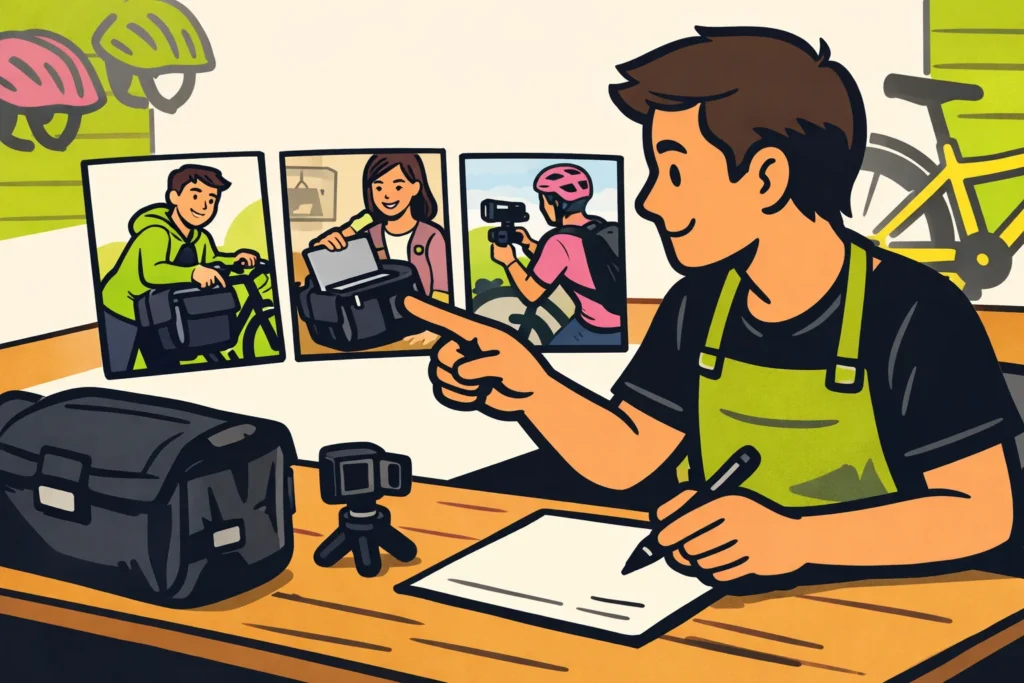
A fictional example: you have a Belgian shop selling bicycle bags. You want to reach Dutch speaking people who cycle to work. In that case, do not search only for sports channels. Videos about cycling to work, rain, and taking things with you may be a better fit.
The creator’s place of residence does not tell you where all viewers live. A creator from Antwerp may also have many viewers from the Netherlands. Therefore, ask for viewer data if the country is important to your collaboration.
Finding YouTube creators: eight ways without a paid tool
Keep a list while searching. Note the channel link, a suitable video, the language, and why the creator appeals to you. You do not need to assess every channel in detail yet. Do that once you have several potential candidates.
- Search for your customers’ questions.
For example, try “bicycle bag laptop rain” or “what to take when cycling to work” on YouTube. This helps you find creators who already explain your topic. Also try different words for the same question.
- Search for reviews and comparisons.
Add “review”, “test”, or “compare” after your product category. Check whether the creator explains who the product is suitable for. A review with pros and cons reveals more about the creator’s approach than enthusiastic visuals alone.
- Search through Google too.
Try
site:youtube.com fietstas review Nederlands. Withsite:youtube.comfocus the search on YouTube. Then change the topic or language to continue searching. - Add a country or place.
Use words such as “Belgium”, “Flanders”, “the Netherlands”, or a city that is important to you. This helps you find local topics. It does not prove that viewers also live there.
- View Shorts and hashtags.
Search for a topic with a hashtag, such as
#fietsen, and watch the short videos. Then open a suitable creator’s channel. Do they also make the type of video you are looking for? A short demonstration is different from an extensive product test. - Follow collaborations between creators.
Pay attention to guests, joint recordings, and other channels the creator mentions. See who contributes content to the video. This can help you find smaller channels that you did not find with your initial searches.
- Ask your customers and look in groups.
For example, ask: “Which YouTube creator helps you choose bicycle gear?” Also see which videos people share in groups about your topic. Review a recommended channel yourself before adding it to your list.
- Find creators from other platforms on YouTube.
Have you come across a suitable creator on Instagram, TikTok, or in a podcast? Check whether they also have an active YouTube channel. Assess the videos on that channel separately. Good results on another platform are not enough to assess a YouTube collaboration.
Searching for YouTube influencers through databases and Creator Partnerships
Is searching yourself not producing enough suitable creators? Then you can explore these two routes. First, check what they offer before paying for anything.
- Review a database or an agency’s directory.
A database is a collection of creator profiles. Check whether you can search by YouTube, topic, language, and country. Also ask how recent the data is. An agency may show only the creators it represents. The directory then does not include all possible candidates.
- Check whether you can use Creator Partnerships.
According to YouTube’s announcement Creator Partnerships is the successor to BrandConnect. Availability may differ by market and account.
Check whether you can use this option with your account. If not, continue searching with the earlier methods and contact creators directly.
Assessing YouTube influencers by their videos, audience, and figures
For every serious candidate, review several recent videos that resemble your plan. Do not compare a short twenty second video with a fifteen minute product test. Also choose videos that have been online for roughly the same length of time.
See how the creator explains the topic
Watch at least one suitable video all the way through. Is the explanation clear? Does the topic receive enough attention? Does the tone suit your brand? Also review previous advertising. Does it fit with the video, or does it feel separate?
Then read some of the comments. Questions about use, price, or experiences can show what viewers care about. Individual emojis or a sudden high number of comments do not, on their own, prove how engaged the audience is.
Ask for the viewer data you need
Are you seriously interested? Then ask for recent figures about the audience as a whole. You do not need viewers’ names or other personal information.
| What do you want to know? | What can you ask? | What does it tell you? |
|---|---|---|
| Where viewers live | The distribution of viewers across countries during a specified period | You can see whether the creator reaches people in the country you want to reach. |
| How many views a video usually gets | Figures from several recent, comparable videos | You do not base your choice on one video that performs much better or worse. |
| How long people watch | The average watch time or the portion of the video watched on average | You know more than just how often the video was viewed. |
| Whether the creator has experience with collaborations | A previous example and the results measured for it | You can see how the creator handled a similar assignment. |
For each figure, always ask which period and which videos it concerns. Can the creator not share something? Mark it as unknown in your overview. Do not fill in the answer yourself.
Calculate likes and comments as an additional indication
You can compare likes and comments with the number of views. Add the likes and comments together. Divide that number by the views and multiply the result by 100. This gives you a percentage. Count the same types of actions for every video.
A fictional example: a video has 6.000 views, 240 likes, and 30 comments. Together, that is 270 actions. The complete calculation is (240 + 30) ÷ 6.000 × 100 = 4,5%.
Those 270 actions do not necessarily come from 270 different people. Views are also not a count of unique viewers. Therefore, the result does not mean that 4,5% of viewers commented. Use the percentage alongside the content, audience, and figures from comparable videos.
There is no fixed percentage that predicts a good collaboration for every channel. Purchased views or subscribers do not prove genuine attention. They also do not guarantee customers, reach that arises automatically, or results from your collaboration. Does a figure stand out? Ask for an explanation instead of immediately assuming that the creator bought numbers.
Approaching YouTube influencers: put your idea and agreements in writing
Use the business contact address the creator makes public themselves. Briefly explain why you chose this particular channel. Mention a specific video, your idea, the preferred period, and your budget or how much flexibility you have.
You can adapt this fictional message:
Hi [name], your video about arriving at work dry is a good fit for our bicycle bags. We are looking for a Dutch speaking creator for an honest demonstration during a daily bike ride. Would you be interested in a paid collaboration in September? We are thinking of one video and have a budget of [amount]. We would appreciate your proposal, rate, and recent data about the countries where your viewers live. We do not want to use the video ourselves as an advertisement. If that changes later, we will make separate arrangements.
Give the creator room to propose their own idea. They can indicate which explanation suits the channel. Before agreeing, ask for a clear quote. What is included in the price, and what costs extra?
Then record these points:
- How many videos the creator will make and what type of videos they will be.
- When the video will appear.
- The compensation, any tax, and product costs.
- How you will check factual errors before publication.
- Whether you may use the footage yourself later, where, and for how long.
- Which results the creator will share afterwards and when.
- What happens in the event of a delay or cancellation.
Also agree on how you will assess the result. For an explanatory video, you can look at views and watch time. Do you want to send people to your website? Then record how you will measure those visits. None of these figures, on its own, proves that you sold more.
YouTube collaborations: make clear agreements about advertising
For paid product placement, sponsorship, or recommendations, the creator must disclose this on YouTube. Local legal obligations also continue to apply. This is stated in YouTube’s explanation of paid promotion.
The disclosure on YouTube is therefore not your complete compliance measure for the Netherlands or Belgium. Which additional obligations apply depends on the situation. Have the current rules for the relevant countries checked before publication.
At a minimum, make agreements about the execution:
- Use a clear disclosure, such as “Advertisement” or “This video contains a paid collaboration with [brand]”.
- Agree where and when the creator will mention the collaboration so viewers can easily recognize the advertising.
- Record who will provide the disclosure on YouTube.
- Also discuss free products and compensation per purchase, not only a fixed monetary amount.
- Check claims about your product. Do not allow performance or results to be promised without support.
These agreements are not a complete legal checklist for both countries. Have additional requirements assessed if, for example, you reach children or promote products with health claims.
Choosing YouTube influencers: compare your candidates with this checklist
Put your best candidates side by side. Enter “yes”, “no”, or “still questions” for each point. This shows what you still need to find out before assigning work.
- The creator covers topics that fit your product.
- The audience fits the language and country you want to reach.
- You have figures from several recent, comparable videos.
- The explanation and filming style fit your idea.
- You know what you are paying and what the creator will do for it.
- You have agreed whether you may use the footage and how you will check factual errors.
- The agreements about advertising and sharing results are in writing.
Does the audience or topic not fit? Do not let a large number of subscribers be decisive. Are many questions still open? Ask them first. If in doubt, you can begin with one clearly agreed assignment instead of immediately committing to a long series of videos.
Also read how creators work on their channels
Would you like to better understand the creator’s perspective? Then read about getting more YouTube subscribers and getting more YouTube likes . To discuss how much editing your video requires, you can read the explanation about editing a YouTube video . If you are also considering paid options, our YouTube services lets you compare packages for subscribers and views, including the available quantities and prices.